The Near, the nearly, and the prior.
There are many similar principled and similarly formed exercises; some
are related historically and some are parallel creations.
The Saga of the Three :
It is generally reported, that 'three teachers [from three
locales and lineages] taught their knowledges to Wu Yi-hui....who would then demonstrate it in Shanghai...and later taught
it as an academic subject at the Nanjing Martial Institute...this would have resulted in a body of three-inputs...and a greater
collective body of addended auxiliary martial exercises.
Yan Guo-xing --- 閻國興 --from Henan-----------\
Chen Guang-di --- 陳光第 -from Hebei ======> Wu Yi -hui 吴翼翚
Chen He-lu --- 陳鶴侣 -from Beijing-------------/
Note : Chan, He-lu, ( Chan,
Hok-kung ) [was considered the prior lineage holder] he was trained by three teachers [as was Wu Yi-hui].
Commentary : It is questionable as to where [?] and from whom [?] and therefore what [?] each teacher
transfered; and it is also plausible that each of the three teachers had had other students during their lifetimes [and whatever
happened to these students' knowledges, which do not appear any place otherwise?].
There is however two notable pieces of data:
1. Both Yan
Guo-xing and Chen Guang-di called their exercise 華嶽希夷門
this implying it was of the HuaYue Sect linked to Chen XiYi, but also
to the Song Dynasty which had TaiZu long boxing.[what Yan and Chen taught differed]
2. The exercise coming from Chen He-lu [the said grandmaster] was called
心意六合八法 meaning
the 'core principles' 心意 of LiuHe 六合 boxing and
methods of BaFa 八法 boxing, but this exercises' manner differed in flowing and swimming
manner. Young Wu Yi-hui, likely did not question his teachers but did cojoin the names. [ although now only the name LiuHe
BaFa is used.]
[Comment: in reviewing this data, it also must be kept in mind that if aspects
of LiuHe-boxing and BaFa-boxing were merged, they may also may not be related to the Shaolin-school styles; an important distinction.]
Note: While Wu was a teacher at the Nanjing Institute, aspects of dragon
swimming were likely also taught; likely derived from closeby teachers.
Wu Yi-hui early
years where :
Tien
Liang [Tieling] : 天梁;
Pien Liang : Kaifeng: 開封
Bian
Liang 汴梁 or
汴樑
Bian liang, Bianjing, Daliang, Liang; prefecture-size city, Eastern Henan. Now called Kaifeng. 開封 known previously by several names is a prefecture level city in eastern Henan Province; the province of Shandong is to the northeast.
Emergence student-teacher Styling : Msr. Wu's most notable 'teaching' locales where Shanghai, Nanjing, and Kunming. He also did some teaching outside
of pre-communist China. There also seems to be a notable difference between the earlier Shanghai version and the Nanjing-66
academic version.
Exercises later taught in Shanghai and Hongkong with style-variations
(taiji-, xingyi-, bagua- yiquan) all called LHPF in principal and form, but visually are not equal to the Nanjing-66 form
nor to the later Wushu-competition adaptations. It also needs to be considered what other Martial arts each teacher knew which
may have been influential to style-manner of exercise.
LHBF-STD : Traditional Nanjing-66 system taught by students of Wu Yi-hui.
LHBF-Xing-yi-style : Chen Yik-yan [+xingyi +bagua] LHBF-Xing-yi-style
: Choi Wai-lun [+Lama +Yiquan]
LHBF-Tai-Chi-style : Fang Pak-xing (Hong Kong) [+Tai Chi-]
LHBF-Ba-Gua-style
: Liang Zhi-peng (Hong Kong) [+Eagle Claw]
LHBF-PRC style : Liang Helen (Beijing-Canada) [+Snake+ Emei]
LHBF-Taoist-style
: Moy Lin-shin [+redesign as Yang-Tai-Chi-style]
LHBF-Hun-Yuan : Monk Ho Yue tim teaches spiraling [hun yuan yi qi zhang 混元一氣掌 ] influencing
a select group in Hong Kong.
HuaYo-TaiChi- : John Chung Li
(Boston); [matrix LHBF +yiquan, +yuan hu]
WaterSpirit-edited : Khan
Foxx [LHBF+ HuaYoTaiChi- +Qi-Aikido +Wingchun, with Shanghai 'water' boxing and zhan
zhuang as a foundation]
Commentary : It could be further outlined that each LHBF, even though being derived from
one of the above channel-sources, takes on the characteristics of each 'teacher' or 'student'. ie. within the collective of
Hong Kong-LHBF, each teacher tends to emphasize some aspect and interpret purpose and application differently.
This is also true for Yi-quan or Yang-Family Tai-Chi-boxing.
Lu Hong Ba-Shi : Lu Hong Boxing
It is generally surmised that upon qigong principles and forms, the LHBF of Wu Yi-hui
includes elements from LiuHe-XinYi- and its' auxilliary 'animal' forms, elements and principles from tai-chi- and from Mi-Zong-I
迷蹤藝 BaGua 八卦 [partly
due to knowledge and exposure to these styles while teaching in Nanjing].
Additional external exercises where adapted [to internal] to the core teaching, from several
Southern 'swimming-dragon' styles inclusive.
There is also the notable inclusion [absorption] of Lu-Hong Fist, 呂紅拳
or Lu Hong Ba Shi 呂紅八勢 [ 呂紅八勢拳 ] which Wu Yi-hui also learned while 'connecting' with LHBF teachers; LH8
was retained and adapted to IMA principles and became part of the formal curriculum.
[ Commentary : Lu Hong Ba Shi or Lu Hong's 8-Imperatives Fist, the
exercise permeates the Nanjing and Hong Kong LHBF style and has been taught separately as a Southern style of boxing.
In general, it is rarely known to most martial artists... hence another reason why LHBF is wrongly compared to other
mixed 3-IMA.
The name Lu Hong can also be a metaphor rather than a name. It
does however carry the idea LU-'note' and HONG-'red', implying an Imperial Directive; the implementation as eight grouped
forms, is sometimes also called 'Eight-Link-Fist'.
In practice it is contrary-wise to the circulating-palm directions of 'ba-gua' 八卦掌
but more xing-yi- like. Some teachers
favor this exercise over the LHBF [Choi Wai-lun]. Although taught with LHBF, teachers make it clear 'it is not a Chen
xi-yi sect exercise.' [Lu Gui-yao]. See separate page for LH8 examples and resources.
Collectively, it is little wonder..that without all of this inter-mingled exercises..that even noted martial
arts historians have trouble classifying LHBF.
Reference
Other Exercises Adapted :
螫龍遊 Zhe
Long You - Coiled Dragon Swimming: fluid body movement; this is more similar to the early water-boxing than is the LHBF.
螫龍拳 Zhe
Long Chuan -Coiled Dragon Fist: serpentine-spiraling characteristic.
龍虎戰 Long Hu Zhan -
Dragon and Tiger Fighting: joint locking methods.
[
Note: it is becoming a practice to list the above exercises as being a standard addendum of 'standard' LHBF styling,
but this is misleading. They are add on's only and taught to enhance and emphasize aspects already within the core LHBF series.
]
LHBF-YiQuan Crossovers and Backflux :
A group of 'top-level' students, trained by Yi Quan 意拳
founder Wang Xiang-Zhai, were sent to Nanjing to study and learn the LHBF under Wu Yi-hui; collectively they have been called
the 'Four Diamonds'. Each student led to an altered LHBF or to an altered YiQuan; which makes practical sense.
1> Zhang Chang Xin 張長信
( 1918?-1990 ) LHBF- "zhu ji chuan" 築基拳
"Though he taught the Liuhebafa form as "zhu ji chuan"
it was highly modified, and using the power Xingyi and Bagua at its core. His version had less stepping and lower-body focus
than the original, using Yi Chuan’s relaxed stepping as opposed to Liuhebafa’s structured transitioning stances,
and himself labeled it the “ lively step style 活歩式 huo bu shi, accordingly. Zhang wrote an
in-depth book on Liuhebafa that was published in 1990, the same year he died.
2> Han Xing-jiao 韓星橋,
Han Xing-qiao ; Cantonese: Hon Sing Kiu, ( 1909-2004; 95 ) created Han Family Yi Chuan, han jia yi quan. 韓家意拳,
Han-jia LHBF 韓家六合八法 Older Brother of Han Xing-yuan; retired to Zu Hai
and taught YQ and his-LHBF; operated a clinic for qi-gong therapeutics. Han propagated the style of Yi Chuan under his own
personal branch of the art called Han Family.
3> Zhao Dao Xin 趙道新 (1865-1938;
73) The best pupil of Master Wang, who later created the boxing: Xin hui zhang 心回掌[樁
Li Chung 李忠, John Chung Li; a well-trained Tai-chi-
teacher in Hong Kong with further training in Tam-tui 'springing legs'; student of 3 LHBF teachers and YiQuan student of Han
Xing-yuan; 韓星垣 ( 1915-1983; 68 ) absorbed standing post
站樁功 and walk polishing steps 摩擦步
mo ca bu from Yi-Quan into his already modified LHBF, publically named: Hua Yue Tai Chi- 華嶽太極拳
This was part marketing and school distinction. It
is also claimed that one of his LHBF teachers Liang Zhi-peng also used Tai-Chi- as HuaYo- style in marketing himslef in Hong
Kong. Later, Li Chung begin absorption of 混元式 HunYuan principles also.
NOTE: there does exist counter gossip that not all of Wang's students
wanted to learn LHBF or that not all of them went to study LHBF. It is important when receiving martial history data to understand
that it is usually accepted without comment and alternative negativity to preserve teacher vanity has been deleted.
4> Pan Yan-Liu Flow-LHBF :
It is also historically known that knowledgeable
teachers of LHBF created their own 'styling' and that Pan1 Yan2 Liu2 潘炎流 created
a Pan Yan Flow = LHBF
潘炎流 六合八法拳.
This if taught intact would have been passed through to teacher-student
Zhou Shu-sheng 周树生 now teaching in Singapore and then to student Helen Liang during
her visits. This did not happen as demonstrated.
The lineage
for this would be :
Wu Yi-hui, 吴翼翚 founder Nanjing-66
forms
>Pan1 Yan2 Liu2 潘炎流 one
of 25 certified Nanjing teachers
>>Zhou Shu-sheng 周树生 currently
teaching in Singapore
>>>Helen Liang [ Liang, Hao; 梁好 based
on available data
>>>>Liang, Shou-yu 梁守渝 [
daughter teaching to her father ]
>>>> Derek Cheng 鄭
>>>>Wu Wen ching 吴雯青 Teacher..Way
of the Dragon School, Rhode Island
However, the large prior history of study of Snake style
and Emei styles by the Liang Family tends to change the usual forms and their manner.
| Peter Ziboce's Zen Dance |
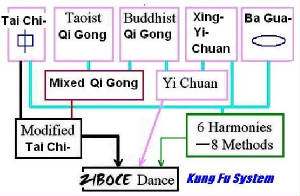
|
| Ze Gong mixed martial exercise |
Mingling of the Best :
Peter Ziboce [1953 - ) 邵保勝 resident of Hong Kong, studied Yang Family
Style TaiChi- with Fong Pak Shing. He received inspiration from Fong on the movement of chi [qi], its rhythm, and its lightness.
In time, after learning LiuHeBaFa, the taichi-ruler, yichuan, and related stylings, Msr Ziboce perceived
that they could be blended and created a 'Zen' Dance, named Ze Gong 澤宮.
My LHBF with applications is mainly inspired from
1, Wu Yik Hui ->Leung Tsz Pang - >Sun Di
- >Ho Ka Hing
2, Wu Yik Hui ->Leung Tsz Pang - >Fa Pak Shing
3, Wu Yik Hui - >Ho Yu Tin - >Tsui Kun Chow
My Yichuan with applications is mainly inspired from
1. Wang XiangZhai >Yao PangHei >Leung TszPang >Sun Di >Ho KaHing
My Yang Tai chi- with applications is mainly inspired from
1.
Yang LuChan >Y. ChienHou > Y.ChengFu >Tung Ying Chieh >Fong PakShing
References:
Alternate Qi-Gong exercise/ concept methods and mixtures
:
There exists, either through historical lineage or through conincidental
absorption, various 'qi-gong' breathing -motion exercises alternatied named hun-yuan, 'original' breath exercises [an alchemical
approach]
Wudang and then..
It
is not immediately obvious that currently 'available' exercises being taught in China and USA [Boston, MA] are closely similar
to the principles and formed patterns of LHBF.
These are collectively
called 'Wudang internal' 武当派内家 boxing; each claiming origin from or development at Wudang Mt.temple 武當山
Some of there names betrays their principles
and some lead into a confusion of historical and cosmological named concepts.
Most Notable :
武當太乙五行拳
Taiyi Wuxing Quan ( Taiyi Five Element Form )
[ Tai Yi Quan 太乙拳 is also known as Liang Yi Quan 兩儀拳]
The opening sequence is almost identical to that
of LHBF.The sequence forms following
parallels that of the first half of the LHBF series. This is surprising and requres further study.
武當太乙玄武拳
Wudang Taiyi Xuan-Wu Quan
太乙游龍功拳 Tai-yi You-Long Gong -Swimming dragon boxing
Tai-yi fire-Dragon Palm 太乙火龍掌
Tai-yi Huo-Lung Zhang
Wudang as a
secular temple of Taoism [Daoism]; Dào jiā 道家 Taoism
and also claims its own 'tai-chi-'
and nei-jia internal principles style.
This includes:
Wudang Chang
San-feng Kung Fu Tai Chi 武當山 張三丰 太極拳
Note: There exists
also a lineage and the methods of Zhao Bao Tai Chi-
趙堡太極拳 which mimics
characteristics of LHBF.
References
Spiral Form, Waving Form Tai Chi =Taiji 浪拳太極拳
The motions of vibrating, waving, or spiraling are intrinic to waterstyle-6x8,
but appear and are utilized ocassionally or extensively in other exercises; this is discussed and presented in the claimed
Wudang-sourced Tai Chi by Erle Montaiue.
Alternate
Exercises, concept methods, and mixtures:
There exists numerous fist-fighting exercises either notably similar to
'water' boxing
in principle or to 'LHBF' boxing in form-principles; this can be through either contact [usually not acknowledged] or through
parallel creation ideology.
3.
Wun Yuan Liu He Tai-Chi- : another Wudang named method
4. Waving hands 揮著手 Tai Chi-: a non-secret method of Mt.Hua
or WuDang?
5.
Yon Quan, Mian Quan : a name is another name.
6.
Si Xiang Chuan : One-source Four-images exercise of Fu Yong-hui.
7. I-Liq-Chuan : Matrix of another flowing-swimming? Or renaming of LHBF.
8.
Shan-Tai-Chi- Boxing-: Swimming- 'Tai Chi' found in Shan-state Mynamar
Exercises
mixtures, concepts, and methods :
"Sun Tai-chi-boxing and LiuHeBaFa-boxing"
This forum discussion was initiated
by 'doc stier' to attract members' contributation into the similarity or mutuality of Sun Lu-tang's styling of tai-chi-chuan
[which is an amalgam of tai-chi-principles, and those of xin-yi-, and those of ba-gua-]. First, the tai-chi principles are
tai-chi- but the applicable forms are derived from Hao-tai-chi- [itself a tai-chi-mixture]. The xin-yi is Sun-tai-chi-forms
[as derived from his teacher] and the ba-gua-forms are Sun's and his ba-gua-teachers [as derived
from Tung]. Thus, already styled as Sun would do each seperately.
The forum advances to the relations of the above with
LHBF and makes two errors:
The first, the use
of 'water' qigong as shown in this website, which is prior-LHBF [or not at all] but which was taught to one of Sun's students.
The second is to
attempt the usual comparison with the core CIMA mentioned above, which Nanjing-HK LHBF incorporates as principles, not as
CIMA explicit forms, close but not equal. However, the CIMA
can indeed be joined to each other, as Master Sun did for his Sun Tai-chi- and others have done. A missing four-patterns form
has also been created by Fu.. Yiquan per Wang Xiang-zhai, although deriving first from xin-yi, absorbs the CIMA into
his Yiquan ...as principles, not forms, and wrote this in document. His student Han Xing-yuan also showed that CIMA could
be joined.
I have considered this also, and have
shown that 'waving hands' with some variations per xing-yi and ba-gua- is a common form and principle for CIMA and LHBF.
|
|
One-source-four-images : 一原 四象拳
Fu Yong-hui's "Si Xiang Boxing" exercise
:
Fu Style martial arts (Tai Ji Quan, Liang Yi Quan, Si Xiang Quan, Xing Yi Quan, Ba Gua Zhang.
There is great variation in the movements
between different styles of Bagua as taught by Tung Hai Chuans.
He would accept only students
who already had skill in other styles; he
would then analyze their movement and body type, and give them things to work
on which fit in with their person. Therefore, each student tended to be
taught different types of movements, and each
master developed a distinct
personal style.
Of the best BaGua Proteges, Yin Fu's style uses a great
deal of piercing palm attacks, and is light and quick in nature. Chang Jung Chiao's style, in contrast, uses
more heavy, palm heel type attacks, and features more low, solid rooting type stances. Yin Fu went on to develop an
'imperial' style of bagua. Gong Ting BaQua Quan, Imperial Palace Ba gua Quan http://www.imperial-bagua.com/
Sources of information :
Fu sheng
long, Vancouver, Canada,
Master Victor, S.L. Fu, 6195 Dumfries Street
Vancouver, BC, Canada, V5P 3B2, Phone: (604)-779-0450
Email: fustyle@fustyle.comBow Sim-mak, 麥寶嬋
Boston, Massachusetts, USA
Shannon Kawika Phelps, Temple of the full autumn moon, del mar Calif.
Journal of
Asian Marital Arts, v.7(4) 1998, pp. 61-81
VOLUME 7 ~ NUMBER 4 ~ 1998
Phelps, S. "One source, four images: Fu
Yonghui's Si-Xiang boxing"
Articles about Fu Style have appeared in Martial Arts Directory
and in
the Chinese Wu Lin magazine, the book, Famous Martial Artists in China,
American magazines Pa Kua Chang
Journal (Vol. 2 No. 6 Sept/Oct 1992; Vol. 5 No. 2 Jan/Feb 1995; Vol. 6 No. 2 Jan/Feb 1996; Vol. 6 No. 6 Sept/Oct 1996),
Tai
Chi (Vol. 20 No. 2, Vol. 20 No.3),
Journal of Asian Martial Arts (Vol. 5 No. 2 1996; Vol. 7 No. 4 1998)
References:
Song Dynasty Tongbei Quan and a link to Hua Shan and Chen
Tuan.
References:
|
 |
|
|
|
|
|
|
|
|
|

